
By: Julia Sequeira
After her morning cup of coffee, Julie Rusciolelli kicks off her day with a face-to-face client meeting. Throughout the day, she meets with numerous business heads and patrons both via Zoom meetings and over dinner or coffee. She consults with her team and leads their meetings every morning, where they discuss strategies for the company, its clients and what her staff have on their plate. She’s in the midst of planning two big influencer events in Toronto. One is taking place in Eataly Yorkville, drawing people in with its Italian-themed food. She is building gift boxes and producing speaking notes for the second event of the week. After that, she has a 3 p.m. meeting with a client. This will be their first strategy call, which will include business strategy and consulting on the political landscape, depending on the client. She’s following up with the four journalists who accompanied her on her 10-day press trip as they are each generating their own stories.
Rusciolelli is the president and founder of Maverick Public Relations. She thinks relationships aren’t possible to replicate via machine. She says PR is more than just writing press releases and producing video content.

Global Communication Report: Does your organization currently use AI in any of the following areas of PR?
According to the annual Global Communication Report conducted by the USC Center for Public Relations, in a sample of about 1000 respondents, 68 per cent say humans will remain essential for public relations to remain effective, and 40 per cent say AI will increase misinformation.
“All the influencers coming, are coming unpaid. So, this is based on our brand relationships that we have,” she says. “AI spit out an influencer list, and it was absolutely crap. So, it’s our relationships that we’ve built over time, AI and anything that we looked at didn’t come close to what we have.”
“Every day is a little different from writing to strategy, to new business, to PowerPoints, you know, all of it,” she says. “There’s a lot of phone work, there’s a lot of Zoom calls, there’s a lot of reading, there’s a ton of prep work.”
For all of Maverick’s PR events, Rusciolelli and her team work together in hand-picking and researching online personalities and influencers.
Cate Celo Alexander is a Doctor of Philosophy at the University of Toronto. Her thesis specialized in content creation, artificial intelligence, digital public history and digital humanities. Her most recent thesis, ‘It Feels So Reel’: Animating Historical Portraits with Artificial Intelligence, which is currently under review, focuses on how misinformation is spread through AI visualizations.
“AI covers everything from like how autocorrect works and like spell check to, you know, being able to identify cancer cells. When we’re talking most of the time about AI, now we’re talking about generative AI,”
-Cate Cleo Alexander
Rusciolelli says that as the industry is evolving, professionals are becoming caretakers of brands. When she first stepped into PR, she was faxing press releases to the Canadian Press; now technology has taken her and the whole industry in a different direction.
“If you look at companies like Starbucks, they never advertised for the longest time. It was based on reputational management, giving a store experience. They weren’t there advertising their coffee. It was all word of mouth,” she says.
Though Rusciolelli is the CEO and president of Maverick, being the leader of a PR agency isn’t just managing; she remains hands-on and active.
“I sit outside the corporate siloed walls. So, I sit outside as an agency consultant. And this is where companies tap us because we work with so many different brands. I can be in working with a finance company today, with a food company tomorrow and I can learn from the bank company and bring it to the food company. And that’s where PR people really shine. We can take learnings from all disparate companies and kind of find a common denominator. If I’m doing a plant closing for a chocolate factory, I’ve learned something from my banking client that I can bring in,” she says.

The chip of the iceberg: Intro to generative AI
“Generative AI usually is working off of a combination of machine learning, usually natural language processing, sometimes a little bit of computer vision. And so it’s helpful to break down exactly what it is we’re referring to, Generative AI. Another way that you can refer to it is predictive modeling. Really what, how it’s working is it’s a really sophisticated version of autocomplete on your phone where it’s predicting what is the most likely word to come next. What is the most likely way that this image would look,” she says.
Data: AI Statistics In 2025: Key Trends And Usage Data, Digital Silk.
Her peer-reviewed abstract, ‘Bringing History to Life’: Animating Historical Portraits with Artificial Intelligence, focuses on how modernization in media by generative AI fetishizes whiteness as it processes non-Eurocentric features as primitive.
“I looked at the ways that AI is being used to manipulate historical portraits,” Alexander says. “What’s interesting about this level of AI intervention is that it’s very insidious and it’s hard to recognize this on how it’s advertised by the YouTube channel that made this. It is just AI enhancement. You see this a lot in how history is being represented online.”
A potential fear with the growth of AI is job security. According to The Future of Jobs Report 2025 by the World Economic Forum, 86 per cent of employers expect AI and information-processing technologies to transform their business by 2030. Additionally, 40 per cent of employers expect to reduce staff due to AI automation.
She says AI is trained to detect what is more appealing, similar to an algorithm. This is done through text but also through imagery and is one of the ways it can contribute to disinformation.
“The way that it’s done the smoothing and this pulling and the way that it’s pulling these images to be more adjacent to contemporary gender standards and also fetishization of Whiteness. That it’s encoding these specific ways of how we understand beauty. Part of why it’s doing that is because the training Data is coming off of modern portraiture,” she says.
But this begs the question: If this is being done with historical images, who is to say it isn’t being done with modern information?
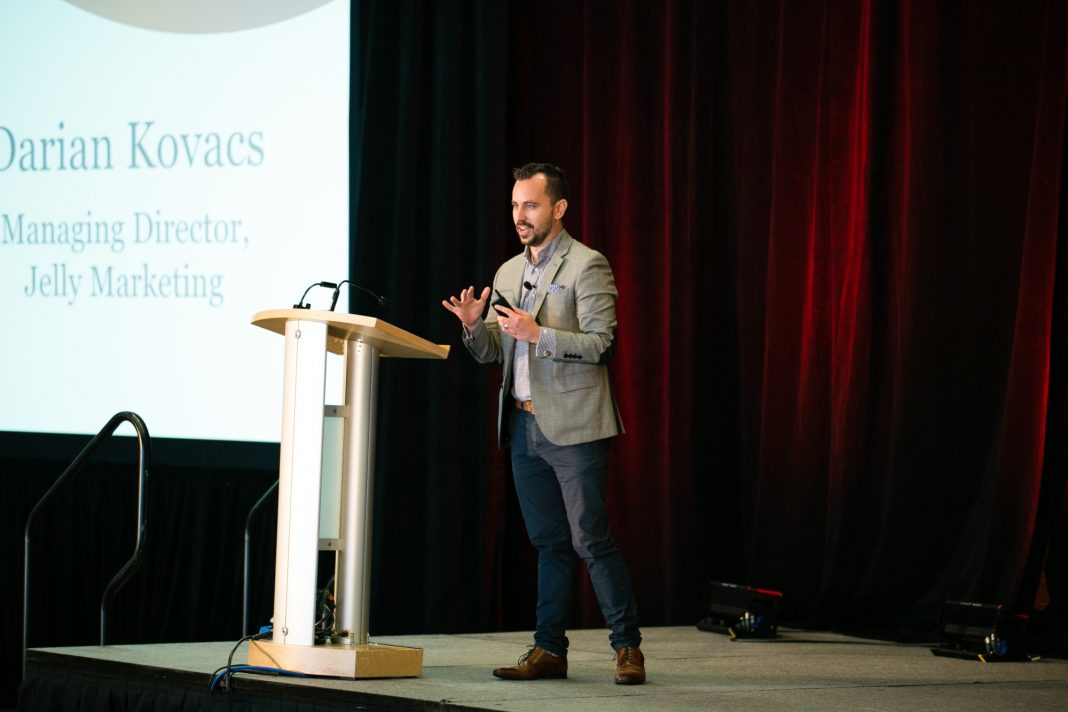
Darian Kovacs is the founder of Jelly Digital Marketing and PR Agency. He is also the founder and a mentor at Jelly Academy, a PR and Digital Marketing school, where his teaching specializes in Public Relations and social media.
”So the one perk has been all these reporters and content creators all now have access to really, really, really good personal assistants at their fingertips all the time. But the, you know, the negative side is like, when people start using it for, like creating content from scratch versus, using it to like edit their existing content or supplement their existing content with better research,” he says.
Private vs. Government Communications

Cindy Giang is a stakeholder engagement and communications analyst for Future Fighter Lead-in Training (FFILT), a program within the federal government’s Department of National Defence. She is a graduate of Humber Polytechnic’s Bachelor of Public Relations program. In her position, she deals with public affairs and is working with others to build the foundation of the whole program.
The federal government’s guide on the use of generative artificial intelligence says it is recommended to use risk evaluation before using AI. For example, high-risk situations should be preceded by thought before the use of AI, but there is no official restriction on the use within the guide.
“I feel like AI at this current present is kind of like more of a tool. So if you were to put in something, they’re going to spit out that exact thing,” Giang says.
She says that AI is lacking humanness in its production. It gives you the information you need but still sounds robotic.
Giang says that PR within the federal government has more guidelines when it comes to how they publish media and present themselves to the public. She says the use of AI templates help her curate a desired tone.
“We have a directive, a policy on how we can use artificial intelligence,” she says. “AI is still relatively new. And we’re trying to put more of a guidance on how we can use it. So, we don’t leak. So, we don’t put the nation in jeopardy or leak sensitive information by accident.”
The federal government’s Directive on Automated Decision-Making explains that “The Government of Canada is increasingly looking to use artificial intelligence to make or support administrative decisions to improve service delivery.”
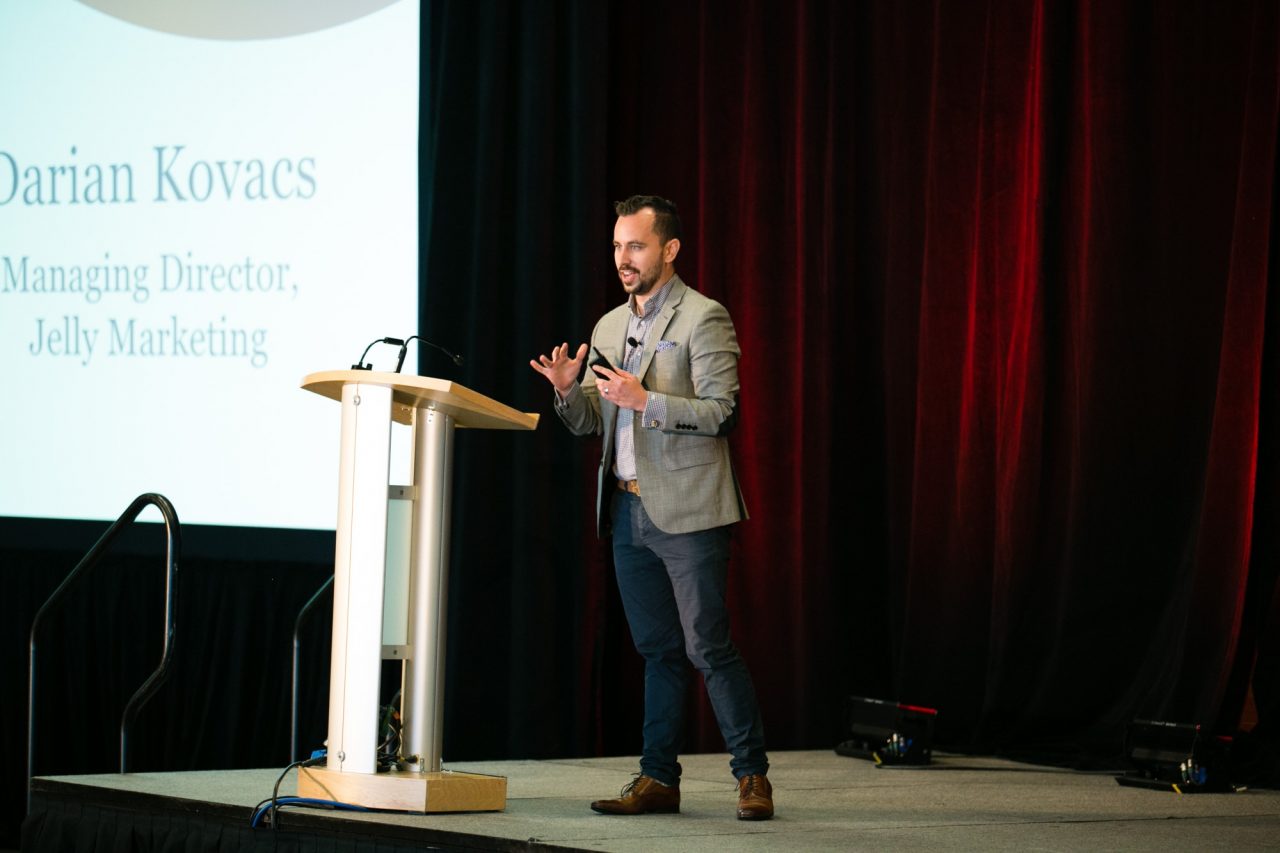
Darian Kovaca is the founder of the Vancouver-based PR, Courtesy/Jelly Digital Marketing & PR and digital marketing school, Jelly Academy.
“But I think, you know, as leadership, you need to kind of set the tone and the bar to be like, Hey, how far can we go? Are you using it to create stuff from scratch? Are you actually using it as a support tool? Does everyone now have their own personal assistant?” Kovacs says.
Humans can be personal assistants and editors, as can AI but it can’t build relationships, connections and brands.
“But at the same time , AI is still not fully there yet. Like, we still need personal assistants. We still need editors. We still need all these checks and balances. So the biggest question we always get at these AI events is like, well, is it taking away jobs? If anything, it amplifies people’s ability and expectations around production, but it has not taken away jobs yet,” Kovacs says.
He regularly gives talks on how generative AI is only usable when humans provide it with information.
Darian recently MCed TESS 2025, an eCampusOntario conference, where he addressed this using what he calls “DI”, Darian Intelligence. His DI is doing what machines can’t – bring a personal touch to his work. In this case, he brought in Pepsi to the Coca-Cola-only event and offering vitamin D pills for those who need uplifting.
It shows that this industry isn’t just emailing and writing press releases.
“Without a person, the use of AI is pretty much useless.. Right? That’s a constant fear, in the media industries, that AI could potentially take away jobs. However, they lack the ability to create content without prompt or without foundation,”
-Darian Kovacs
Sleeping with the enemy
Though it has been established that AI doesn’t offer the same plethora of resources as a PR pro, there is still the fear of brands outsourcing AI platforms as a subpar substitute.
In October, WPP Media, formerly known as MGroup, launched its new edition of its AI marketing platform, WPP Open Pro, which is a fully AI company that allows brands to do the jobs of public relations, marketing and advertising on their own. The company says that the AI model increases content volume by 33 times, resulting in a team of four working 90 days less in a year.
Rusciolelli says the key to job security may be to collaborate with generative artificial intelligence.
“So, let’s get off fighting it and let’s get in love with it, let’s get in bed with it, but let’s work with it and make me even better as a PR professional. So that’s out of the gate. Someone that prides themselves as a great creative writer and strategic thinker, which I think I am. I go to AI as my research assistant,” she says.
Rusciolelli says that she has seen people racing to find the best writing tools as a result of the proliferation of AI in the past three years. As of right now, she sees how quickly the technology is changing, especially in the past year and a half, but she knows the industry in a way that only a human can.
“I’ve been a public relations professional for 36 years. This has been my life,” she says.
“I don’t know anything outside of public relations, so damn if you will. AI is not taking my job.”
-Julie Rusciolelli