
By: Benjamin Steeves
On Nov. 13, 2025 Humber Journalism students attended a full-day symposium where journalists from across the Canadian media industry joined panels to discuss Trust in Journalism.
New journalists took their seats in the early parts of the morning, with notebooks and pens in hand to listen to keynote speaker Brent Jolly, president of the Canadian Association of Journalists (CAJ) and managing director of the national NewsMedia Council of Canada.
Jolly discussed the research that has been done looking at diversity in newsrooms since the late 1980’s, mentioning TMU professor John Miller, who released two reports a decade apart, one in 1994 and the other in 2004 looking at the Canadian Daily Newspaper Association.
“Diversity isn’t only about who gets hired, it’s about who gets heard, who gets promoted and who gets supported once they’re inside the newsroom,” says Jolly after speaking about the increases to Black, middle eastern, non-white and gender gaps narrowing since data collection half a decade ago.
Jolly adds that while there have been increases in representation among Black, Middle Eastern and other non-white journalists, as well as some narrowing of gender gaps in recent years, progress remains slow.
“Our ability to see ourselves in others across color, class, belief, order and many other things is what keeps the world from fragmenting into fear,” – Brent Jolly
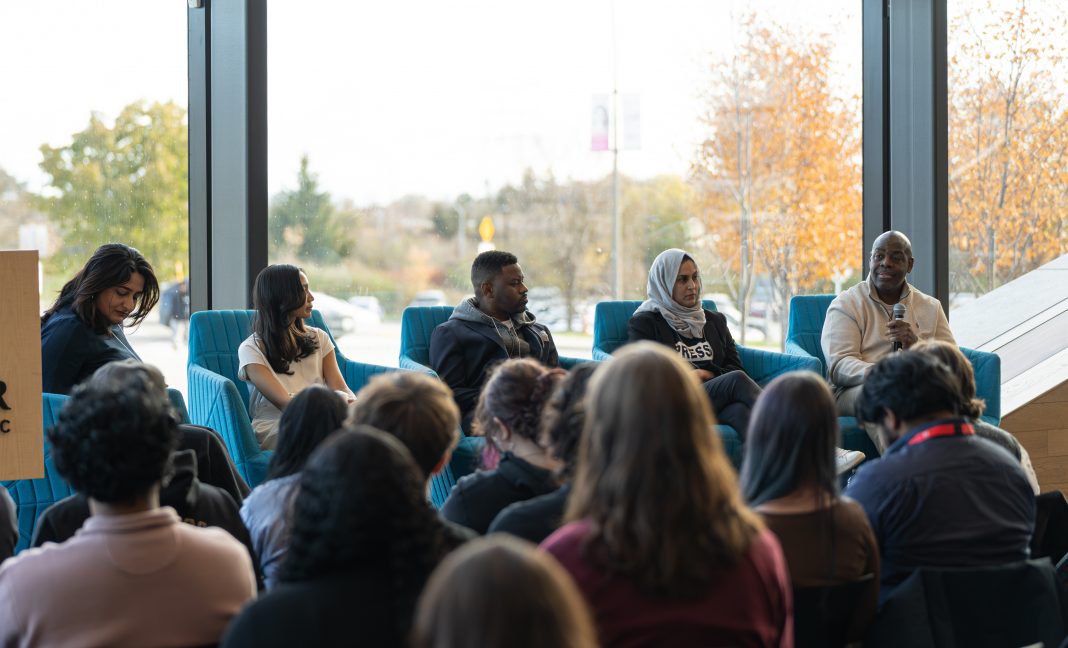
Following Jolly’s discussion was Journalism After The Reckoning panel that revisted Humber Journalism’s 2020 The Reckoning: Racism in Canadian Media symposium. That event was hosted virtually during the COVID-19 lockdown following backlash in media calling out student j-schools and newsrooms in general, for running antiquated and racist newsrooms.
Moderator Mahnoor Yawar from CBC and panelists Donnovan Bennett formerly of Sportsnet and freelance journalist Shenaz Kermalli returned to the discussion five years later.
They were joined by recent Humber journalism graduate Annicca Albano who works as a journalist and programs and community engagement producer at the Canadian Journalism Foundation and Nick Davis, CBC’s executive director of equity and inclusion, to discuss what has changed since the media reckoning.
While the panelists came from different backgrounds, they stood united on creating an influx of awareness surrounding racism following George Floyd’s murder. Many companies, they felt, were using that ‘trend’ promoting backlash on shallow public statements and corporate Diversity, Equity and Inclusion branding with very little actual measurable institutional change.
“I felt like a collective trauma was being used as a trend,” Bennett says it was being marketed and commodified for optics rather than justice.
While there have been improvements to hiring and who gets hired and promoted, mentorship and protection have stayed mostly the same if not going backwards in some ways.
Albano says she “didn’t know the colour of my skin mattered until I landed here,” previously working as a journalist in the Philippines stating, “journalism should be fact-based and that the stories reflect the people it serves.”
At the centre of its core, the panel envisions a future of journalism with long lasting change, still achievable if power, not simply access changes.
That promise is already taking life in the next generation of journalists, who are actively reinventing what connection and representation may look like.
The following panel of postgraduate journalism students showcased this by making community connections in attempt to reestablishing trust and forging deep relationships one interview at a time.
The team of Humber journalists worked on stories involving community outreach in and around the Jane Street and Finch Avenue area, where they researched the real struggles people face there.
Students revealed that they went into the neighbourhoods with preconceptions influenced by other external media coverage of crimes and headlines.
Key takes were participants were more eager to speak in locations where they already felt comfortable, like parks, food courts and street corners rather than informal interview settings. They found once they stopped approaching it as an assignment, the conversations flowed naturally.
Students agreed the experience fundamentally changed their perceptions of media and the communities it serves.
Mike Wise, program coordinator for Humber’s journalism post-graduate certificate program, moderated the following panel joined by Wilf Dinnick Co-Founder of GetFact and senior news producer of CBC David Michael Lamb they emphasized the importance of fact checking, accuracy and how to spot AI driven information.
Public trust in the media is already critically damaged which makes the rise of generated material and disinformation much more perilous. The panel highlighted that roughly 28 to 37 per cent of individuals express trust in what they see and hear in the media. Suggesting skepticism has become the usual response, rather than exception.
Because of this, the burden of verification no longer rests exclusively with journalists and the common reader but not to rely on AI detection techniques.
According to Lamb, “most of them are not very reliable because developments in AI are proceeding faster than the tools that detect that stuff.”
One solution the panel offered was transparency of showing audiences and readers how verification is carried out rather than only requesting or assuming trust.
They highlighted that editorial supervision is still the most crucial factor, noting that recent media failures generally arise from weaker gatekeeping rather than the technology itself with the panel’s final finding to be the most sobering.
Since social media companies are unlikely to handle verification, journalists, educators and regular users, will now have to bear the brunt of the task.
At the end of the day moderator Lara King, program coordinator for the journalism advanced diploma program at Humber welcomed to the stage Toronto Star’s Robert Benzie, MacLean’s Editor-In-Chief Sarah Fulford, Laura Green with CBC, San Grewal founder of The Pointer and CityNews’ Nick Westoll. They spoke candidly about hiring expectations, newsroom culture and the growing gap between how students envision journalism and what the job truly demands.
The most important aspect of the conversation was preparedness. Editors underlined that one of the most common mistakes candidates make is neglecting to really consume the outlet’s material.
They also stressed dependability, stability and flexibility matter more than sheer skill or writing potential.
The conversation also shifted to discuss social media and professional identity online. Concerns about how public political beliefs on the internet might undermine the credibility of a particular journalist or even newsroom.
Panelists agreed that younger journalists bring crucial strengths such as digital fluency, multimedia storytelling and fresh new ideas and methods of interacting with audiences that newsrooms are increasingly relying on.
They wrapped with a sense of cautious optimism, although the industry continues to develop with technology and altering public trust, the next generation of journalists is entering the sector with the tools and the understanding and intent to reshape it responsibly.
One thing was evident as the symposium ended, journalism’s survival rests not on just who tells the stories, but also on how ethically and compassionately stories are delivered. From conversations on diversity to community trust, each panel highlighted the pressing need for both responsibility and agility.